Showing posts with label Essay. Show all posts

Tuesday, November 11, 2014

Week 13 Essay: Do Vampires Have Qualifications?

It’s been interesting reading these folktales and seeing how different cultures describe their undead. Like, for this week’s reading it was being a warlock. The stories talked of vampires as being dead warlocks who pop out to do evil deeds. They killed people, yes, but generally did not drink blood (or eat them - so not zombies either) or flee from sunlight, garlic, etc. so do they qualify as vampires? Is it just a name, or do they have to qualify? What are those qualifications? Do they vary place to place?
Considering the evidence (I have quite an extensive list since I got really into vamps during eleventh grade - I’ve got more than I thought, actually) I can only conclude it varies. I mean, looking at disposal alone can bring about that conclusion! We’re used to a wooden stake through the heart. In Bram Stoker’s Dracula it was actually a wooden stake in the heart (had to stay there, but it mainly immobilized the vamp, not killed it), cut off the head, stuff garlic in it’s mouth, and place it between the legs when burying the body. In Nigeria there are no stakes or garlic involved - you killed a vampire by driving a nail through it’s left temple. Others have you burn the body and scatter the ashes (Anne Rice did it first Twilighters) or get it in sunlight (even though modern media doesn’t like this one because it severely limits your main character’s options), place metal over the eyelids, use silver bullets (even though it’s more commonly associated with werewolves, it is the common lore of some vampire tales), or even as simple as placing a lemon on the mouth of the corpse for a suspected vampire.
I told you it was an extensive list.
So really, who’s to say you can’t claim it as a vampire? The Russian folktales have them all former warlocks - okay great. They are killed by the cross and silver - sure! As long as they are a dead body that moves around as a conscious, animate being and doesn’t wander aimlessly devouring flesh (therefore being a zombie) I’m pretty sure you can call it a vampire. 
Unless it sparkles. Then it’s a fairy.

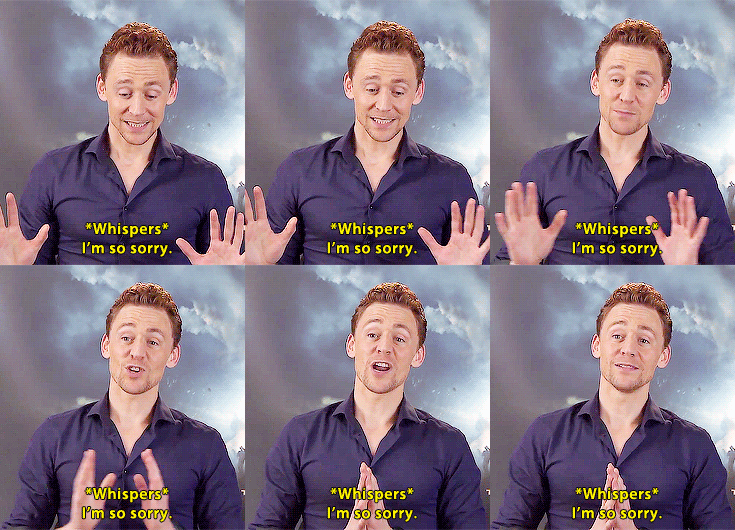
(Snape telling it like it is. I found it here)
(20 points if you got the reference)

Week 14 Essay: The Problem with Mages


So, I did the Väinämöinen reading this week, and I loved it (epic poetry not in prose - yay!) but I found myself running into the same old problem again:
If you’re this all-powerful mage, why don’t you just mop the floor with everybody?
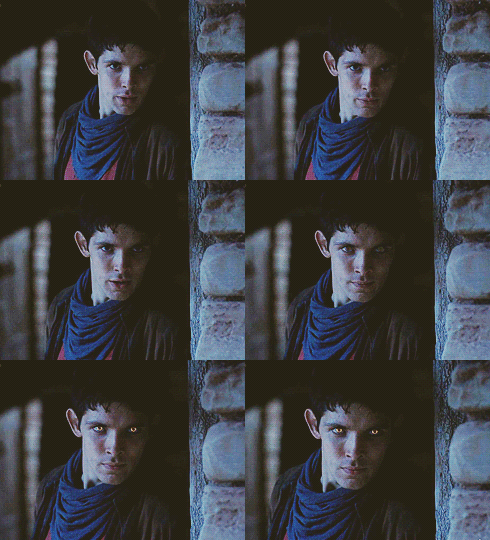
See, this happened in a BBC show called Merlin, too. It’s a great, very cute little retelling of the Arthurian legends where Arthur is still a prince, Uther has outlawed magic, and Merlin becomes the manservant of Arthur. He’s informed by a dragon of his destiny to serve Arthur and protect him so he can become the Once and Future King and return magic to the land, and eventually the two become bros. But while the show ends its first season with Merlin basically getting power over life and death itself (within some rules) that’s basically as epic as it gets. Oh yes, Merlin has some other fantastic moments, but they’re not nearly satisfying enough. It’s either Merlin alone with just the bad guy in a cave, or being secret so no one knows he saved their butts, or Merlin is disguised as an old man.
Like, no. Just no.
I want an all-powerful mage who is also one bad ass mother fucker. I want him to look at a field of enemies and just go - “hah, right, later” and call fire down from heaven to decimate the field and destroy all his enemies.
Okay, I understand that someone who is all-powerful all the time with no conflict makes for a boring story. But come on! If you tote the main character as the most powerful sorcerer to ever walk the earth, he shouldn’t get taken out by an arrow to his shoulder. Not even near his heart! Instead he falls into the ocean and can’t save himself. Really? I understand adding drama and conflict, but completely ignoring the canonical facts about your character in order to do it - without any stated legitimate reason - is just infuriating.
There is nothing wrong with a character who blows through the opposition every now and then. Nor if he does so on a fairly regular basis. Heck, that’s all Liam Neeson’s character does in Taken, and that movie was highly successful!
I just want my characters who have badass potential to be badass, is that too much to ask?

(I just really love Merlin okay guys? Web source: rebloggy)

Thursday, November 6, 2014

Week 12 Essay: Remember, Remember, A Story from Last November

The Celtic Fairy Tales Unit was a very cool unit. I enjoyed the fresh perspective in all these different tales. It’s interesting to go back to the fantasy setting that I’m more used to after reading tales from everywhere else in the world. This unit was also just a lot of fun. I mean come on, leprechauns and witches and giants (oh my)! What’s more fun than that? It was a very light reading too, which was especially nice since I’ve been so bogged down recently.
The thing that stuck out the most to me was probably how similar Connla and the Fairy Maiden was to the Arthurian legend Lanval that I read in a previous class. In that legend, a knight is traveling and stumbles upon a court in the middle of the woods, with a sorceress queen who declares him her husband if he will never tell anyone about her. He agrees, and they live happily till he has to go back to court. There, Queen Guinevere tries to seduce him but he refuses. She won’t believe him when he says it’s because he has a lady, so he has to reveal his mystery wife. Then Guinevere accuses him of assault, Lanval is sad because his lady doesn’t visit him anymore, and Arthur wants his head. The unnamed lady does come to save him and spirit him away, but not till the very end.
Okay, it’s actually very different. I’ll grant you that. But the mystery maiden of great magical powers swooping in and finding herself a husband despite the whole court being opposed to it? That’s in both of the stories (basically). I was also remembering it slightly wrong when I read the Celtic tales unit. Oh well, it’s been a long week and we can’t all get it right all the time now can we?

(apology gif from Tumblr bowels because I know this is a crap essay but I'm honestly on so little sleep this is the best I could do - literally, you should have seen what it was pre-revision.)

Thursday, October 30, 2014

Week 11 Essay: Poetry vs. Prose


I don’t really get why all of our stories happen to be in prose form. Poetry can be intimidating, yes, and I know a lot of people have horrible memories of poetry from high school and so tend to shy away from it at all costs. They think Shakespeare or Chaucer and want to run and hide. I blame a lot of that on the school system, considering teachers present it to you like it’s the hardest stuff in the world and you’ll never be able to understand unless someone explains. But actually guys, poetry is not that hard. Ever heard of Occam’s Razor? It’s a theory that says the simplest explanation is usually the correct one, and he’s right. All of this stuff about poems observing flowers on rainy days standing as allegories to the Holocaust are utter nonsense ninety-nine percent of the time and started because of Reader Response Theory.
What’s that? Don’t worry my non-English Major friends - I shall explain. You see, in the early days of literary criticism, all anyone cared about was the author. They looked at the life of the author and the history of the time in which the author lived and used that to try and figure out what the author meant. These schools of thought were the largest, and for many years were the only ones out there. Then, inevitably, came what I like to call the Trend Swing. As in all things, literary critics rebelled against the system and went in the exact opposite direction. Thus came Death of the Author and Reader Response Theory. They took the author out of the proceedings entirely and stated that the true meaning of a poem is whatever the reader gleans from it. And since people are different and everyone interprets poems differently, the stated ‘no wrong answers in English class’ came about. With this nice little scholastic shield, people thought up crazy things like the above example, and because scholars like to make things ridiculously difficult and clever whenever possible they took to it like a fish in water and ran with these outrageous ideas so long it became a teaching cannon.
Guys, sometimes a blue curtain really is just a blue curtain.
But our years in school define lots of us, instilling instinctive fear and trembling at the mere thought of reading poetry. Irving? Longfellow? Gah! And don’t even get me started on [insert fear and trembling and mental breakdowns] Shakespeare!
Thankfully, I grew up reading Shakespeare and with a theatrically-minded mother, so I was largely immune to this conditioning. Which is why I look around at my fellow students and just feel depressed. An avid novel junky, I will be the first to proclaim the wonders of prose from my soapbox to any bored pedestrian who will listen. But there’s just something about well-written poetry. Refusing to read the Homer, Virgil, and Dante units was mainly because I read them all last year, but considering I could have then skipped the reading and done those weeks from memory (thus saving a lot of time to devote to a college students favorite pastime - procrastinating!) I wouldn’t touch them because they’re prose. Virgil is not meant to be prose. Epic poetry is not meant to be written in prose - period. I know poetry sends some people into convulsions, but it’s not that bad. Honestly!
If we’d all get over this taught fear of anything written in staggering lines instead of a neat left-to-right block the world would be so much bigger! Prose sounds stilted when it’s converted poems because poetry takes time to describe things. Yes, Homer goes off on a lot of tangents (I’ve read both his epics and yes, it bugged me too at times) but they’re lovely. Poetry has a way with words you don’t find anywhere else, a way to sweep you off your feet and show you the world from a new angle. That’s the entire point of poetry, and the defining mark of a good poem. Every time I read the words ‘converted to prose format’ in the notes to our readings I just get sad. There is nothing wrong with poetry, guys, and anything less is just disrespectful to the author and the work itself. It takes a lot to write an epic poem and get it all following the correct rhyme scheme and format.
Call me a snob if you want - considering my major it’s probably at least somewhat true.

 
()


Wednesday, October 22, 2014

Week 10 Essay: A Good Set to Read as a Pair

This week I read the Eskimo Folk Tales unit, and it was a lot of fun. Especially since I read the Alaskan Legends unit last week, and so I had a lot to compare and contrast it with. Both units have to deal with Inuit tribes, yet beyond snowy settings and seal hunting the two don’t really have anything in common.
In the Alaskan Legends unit, you see a lot of stories about where man came from, and why the sun goes away for long periods of time. The stories have a few folk tales but mainly fall more in line with themes common to mythology. The Eskimo Folk Tales unit, on the other hand, was more in line with what you’d expect - lots of stories about families in fantastical situations, ghosts and adopted bears, jealousy, love, that sort of thing. Very little to do with gods and large questions about why the world is as it is, and more general stories of ‘such and such happened to a guy named Bob many years ago’.

Perhaps it’s just a culture thing, but here in the south legends tend to be only a little different than folk tales, so the difference between the two units was honestly a little astounding to me. Many people would call something like Paul Bunyon a folk tale, while the whole title is “The Legend of Paul Bunyon”. Legends are the same as folk tales, just generally a smaller story, fewer characters, closer to home, and a much more localized thing than folktales are. So going into this pair of units, I thought I’d see very similar stories. I was entirely wrong, and pleasantly so. This enabled me a larger bit of the literature pie, so to speak. It wasn’t a few stories told different ways, but a large collection of many different stories. I highly recommend reading this as a pair - it was entirely worth it.

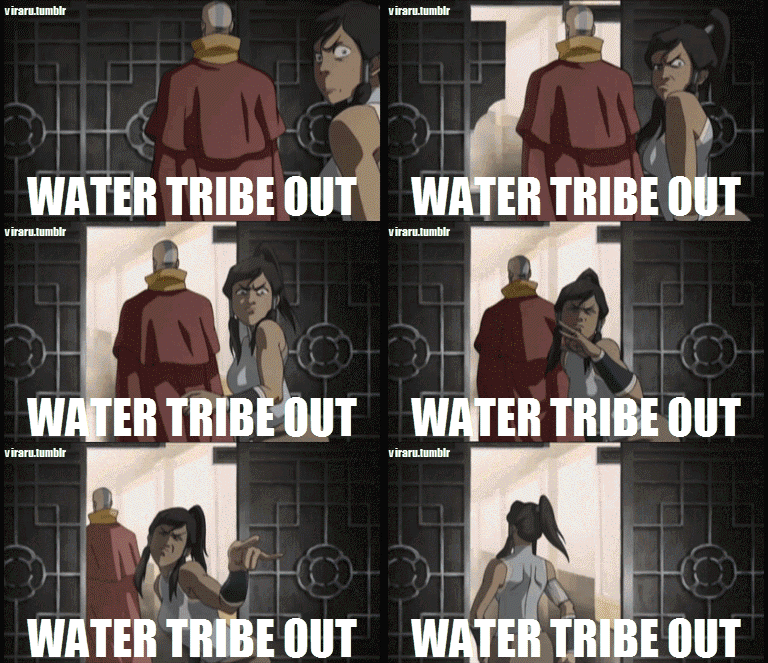
(Korra of the Southern Water Tribe - gif by Viraru)
(I just really love Avatar okay guys?)

Friday, October 17, 2014

Week 9 Essay: Location, Location, Location

The most interesting thing to stand out when I was reading the Alaskan Legends Unit was the duality of Raven. For the first several stories Raven is your normal head-god-type character. He shapes, he teaches, he guides humanity through the first stages of civilization. He fulfills the role of the main god perfectly, giving humanity laws to follow and punishing them when they disobey with things like taking the sun away and flooding the world.
Then abruptly, it shifts. Somewhere between “Raven’s Marriage” and “Raven and the Seals” Raven seems to depart almost entirely from his role as head deity and takes on the role of the trickster instead. He holds a large feast with the intention of seeing a hat and blanket. He finds himself a wife through braggings and showing off, ultimately being unable to keep it up. He finds the seals just so he can eat mass quantities of them daily. He tricks Pitch into fishing past sunrise so he can use the melted substance to repair his boat and keep the fish they caught for himself.
In “How Raven Stole the Lake” things change once more, but to a combination of his previous roles. Raven steals an entire lake from where it laid, but he does it to fly it home to a human tribe and place it near them so they are able to live better, aided by his teachings about the new feature of their landscape.

In some stories Raven is just the head deity, in others he is a trickster little better than Anansi, in still others Raven is an odd combination of the two archetypes. One thing that can be said for this is the fact that the Alaskan natives all lived in different tribes stretched out over a wide expanse of land. The note under the title states which tribe the legend comes from, and it has a direct correlation with how Raven is seen. Those in the Bering Straits view Raven more as a head god. The Tsimshian hold the legends of Raven as a trickster. It’s a very interesting look at how location oftentimes decides the structure and fate of a story.

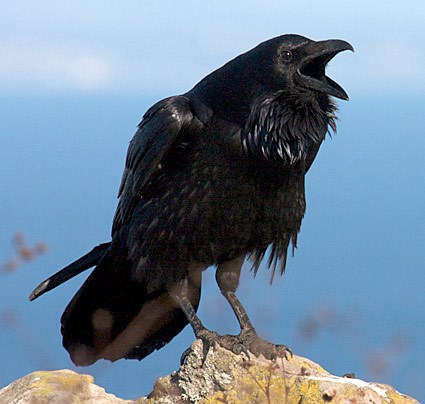
(Raven - web source)

Friday, October 3, 2014

Week 7 Essay: One Old Trope That Can Die

One thing that kept hitting me while reading The Legend of Yamato section was just how often, across all cultures, there are tales of women who love unworthy men - completely and utterly love them. In the section, Tacibana becomes Yamato’s wife. It starts as all do - with everyone happy and in love, and then the other shoe drops. Yamato gets bored. So what does he do? Wander off and goes to find another maiden to love.
Old Japan (and indeed many other older cultures) may have allowed polygamy as long as the man could support each family, but in the story itself this move is said to have been to Yamato’s shame. For Tacibana was perfect in every way, she was the ideal wife for the standards of that time. Yet Yamato gets bored and starts to go pursue sirens. Tacibana doesn’t yell, she doesn’t rage, she just weeps for her portion and waits for him to return, praying all the while for his safe journey.
Like, really? Seriously?
This sort of thing likes to happen in literature a lot, and it’s not just in fairy tales and folklore. In The Gilded Age, a Mark Twain novel, we see women who hang on their husband’s every word, agree docily with them all the while, and even when abused and left for dead they return longing for love. In Shakespeare’s A Midsummer Night’s Dream we have characters like Helena, who follows after Demetrius trying to get his love even when he curses her and threatens to rape her. Victor Hugo wrote Eponine in Les Miserables, who follows after Marius wherever he goes. Marius is entirely blind to her devotion, but Eponine loves him so much she actually introduces him to the girl he’s in love with! And then if that weren’t bad enough, she later follows him to the barricades to remain beside him during their tiny revolution and gets shot by soldiers on her way there.

Come on ladies, wake up and smell the roses! When a man dumps you, sob for three weeks, devour mass amounts of chocolate, and move on. If a man is unworthy, dump his sorry butt. Life isn’t a romance novel. And I understand that yes, women do get that lovesick crazy so there’s serious precedent for this literature trope but after a while you just get sick of it. High literature should be about so much more than this.


"He was never mine to lose. Why regret what could not be?
These are words he'll never say - not to me." 

Lyrics from Les Miserables, "A Heart Full of Love". Image of Eponine and Marius from Les Mis. Web Source

Thursday, September 25, 2014

Week 6 Essay: Justified by Means

The Anansi stories are nearly all about the same thing - gluttony. Anansi tricks people so that he is able to eat exorbitant amounts of food. Yet as most tales have him getting away with such actions, one comes to wonder if his actions are condoned more than they are condemned.
Yes, partly this may just be cultural differences - but while being able to eat a lot is desired, being a glutton is generally frowned upon. Gluttony is most often defined as too much, too fast, too often. Basically, it is an excessive intake. Our little spider fits this bill perfectly. He tricks people into letting him devour their food until he is gorged, and then  comes back to do it again the very next day (see The Gub-Gub Peas). Anansi is never satisfied with ‘just enough’, he must eat all that there is and more. More often than not he succeeds.
Anansi is constantly eating, but he is also constantly using his cunning. The tales make a point time and time again to state that Anansi uses his cunning, he thinks, he outsmarts. The only times he loses is when other watch his tricks and then turn the tides to outsmart him. Perhaps, with all the insistence on his cunning, that aspect is being glorified more than the end to which he applies it. Anansi is a glutton, but he is a cunning glutton. Anansi uses his brain to outsmart those around him so that he can get what he wants and that should be commended, even if what he wants isn’t exactly on the side of moral right. After all, everyone loves a good villain, even if none of us are likely to cheer him on.
Anansi wins in most of the tales, because his cunning is to be admired. So for Anansi I guess the means justify the end. Or, in this case, the beans.

 
(Joanna Gleason in "Maybe They're Magic"


Thursday, September 18, 2014

Week 5 Essay: Underwhelmed Reading

The reading unit for Egyptian Mythology was slightly disappointing, in all honesty. I feel like there was a lot more that could have been done with this unit. It was nice to see the folklore in there, but the focus of stories had a very narrow scope. There’s such a richness and variety to Egyptian myths that you just didn’t have here and it was sad to see.
As for the stories that were included, I had mixed feelings about them. The Creation one was really just a slightly different take on just about every other creation story ever (they all end up sounding the same after a while) though it was interesting to note all the elements of other ones and how they’re used here. The Secret Name of Ra and Ra and Hathor were really neat ones, especially considering in Ra and Hathor they end up just barely avoiding a flood story. The Sun’s Journey was boring - kind of an endless list that could be summed up in a few sentences. Likewise the Osiris group*  is just about the most commonly known myth in Egyptian mythos and more of a chore to read than anything since everyone knows the story already. The Wax Crocodile and The Green Jewel were interesting simply because they’re little known folklore. A bit more context would have been nice, as I was really confused as to why the son was telling his father random stories. TWC was very neat and entertaining, but TGJ was mediocre and boring - like he goes sailing with his harem, whatever, who cares? The Two Brothers was… odd. It had a lot of classic fairy tale elements, and kind of reminded me of The Ramayana. I’m not really sure what to think about it. The Book of Thoth was likewise entertaining but kind of odd - I did like this one however. Same with The Tale of King Rhampsinitus.
    Overall I wasn’t terribly impressed by this unit, and only a few of the stories were entertaining. Some mythos concerning other gods would be nice, as well as a bit more context for the folklore. Granted, you don’t tend to be very forgiving when you’re running on three hours of sleep, so it may have just been me.

(Worship of Aten aka Ra. Web Source)

------------------------------------------------------------------------------------------------------

*The Osiris group were the stories Osiris, The Death of Osiris, The Journey of Isis, and King of the Dead

Thursday, September 11, 2014

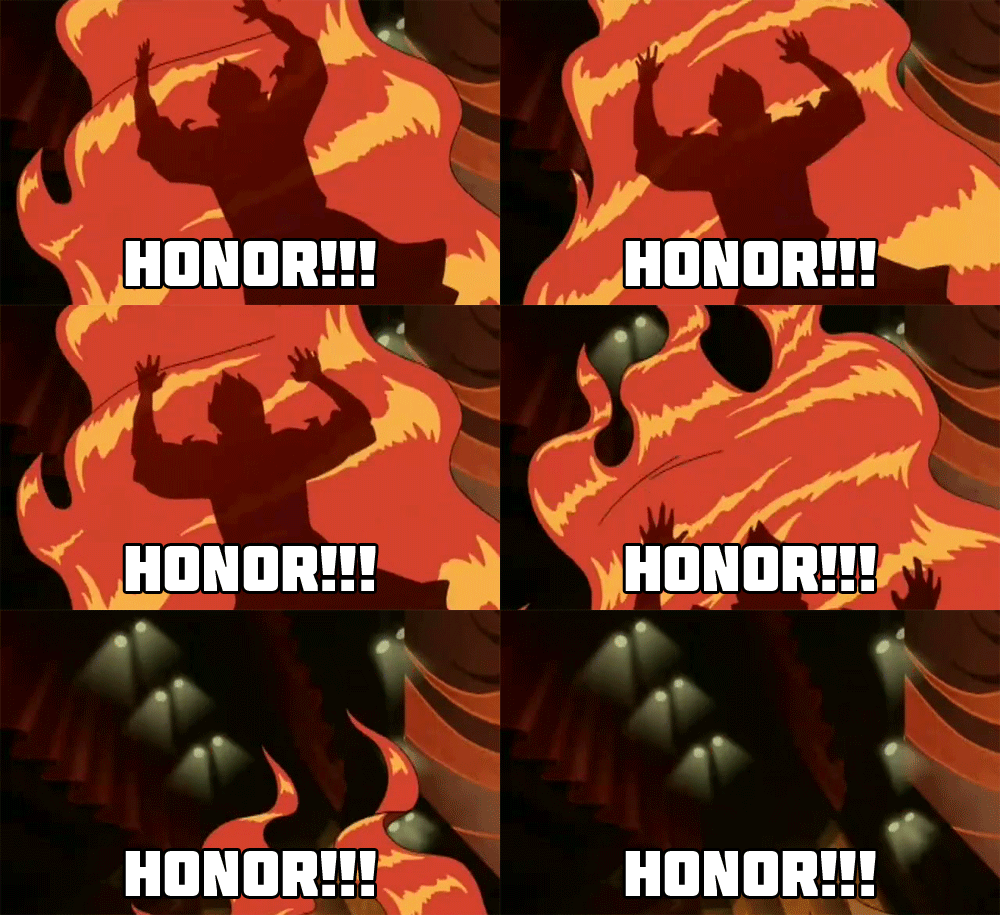
Week 4 Essay: Enough With the Honor!


In the story Twenty-Two Goblins, the King is rewarded because of his impeccable, untiring honor. This code of honor seems to be a rather common motif in Indian tales. In a previous class I read parts of the Ramayana and this same code was seen throughout. Perhaps it is just the culture difference, but these two tales seem to carry this notion of honor far above and beyond anything western folklore will say. If Twenty-Two Goblins had been a German or Swedish tale, the king would have had to answer three riddles, maybe five or six if it was an especially long tale. But twenty-two times, without lying or just gagging the stupid goblin, is far too many for a western folktale. Yet time and again the king returns to the tree and begins his task anew, without wavering or faltering, without bitterness or despair.
All this, merely because a priest who honored him has asked him to. The King doesn’t know what the priest wants with the goblin, what his plans are (which turn out to be quite nefarious), or anything about this man other than he keeps giving the King precious stones. The process seems quite like the Arthurian Romance theme of a rash boon: the granting of a favor before you know what it is. Countless times a knight will ask King Arthur for a favor, and Arthur will agree before ever hearing what it is, which normally gets them into a bit of trouble. But the King in Twenty-Two Goblins isn’t granting this. It’s not a rash boon, but instead his sense of honor repaid that drives the King to endure this challenge. It is a cultural norm that goes above and beyond the most chivalrous code of honor in any western tale. It’s fascinating. It’s infuriating.

You read these tales and think ‘please just gag that stupid goblin already!’ But due to this code of honor the King can do no less than be an annoyingly perfect individual and not act with a single toe out of line. The same thing happened in the Ramayana, where Rama willingly goes into exile in the woods to ensure his father will remain honorable in granting a rash boon, and Rama is genuinely happy to do this. The King in Twenty-Two Goblins holds the exact same set of standards for his code of honor, and undertakes this long, arduous task of getting the goblin while also holding to the goblin’s rules in this riddle game. The motif is interesting, but hard to understand from a western perspective because I spend the whole time wondering why no one will just shut the goblin up so they can complete the task and go home. If being sneaky to get the job completed correctly goes against the motif, then I guess dishonor on me, but I’ll get to sleep before anyone else.

(If you don't know - DISHONOR ON YOU)

______________________________________________________________________________

Image Info: 
Image one is Prince Zuko from the show Avatar: The Last Airbender. More specifically, an episode called The Ember Island Players where the show spoofs itself and the characters go watch a play that is basically a summary of their adventures up to this point. Web source
Image two is Mushu from Mulan. Seriously guys, do I even need to put this here? Web source.

Friday, September 5, 2014

Week 3 Essay: Where's the MEAT?

For this week’s reading I did the second unit for Ovid. The first part of this section dealt with Pluto and Proserpine, and it seemed a little stunted. Then again, Ovid does take the stance of it being a rape, and so the myth isn’t as full as it is in the Greek. In the Greek Demeter goes off and takes on a surrogate child in her grief, and Persephone is in the Underworld for quite a long time before Demeter finally demands her back. Plus, Hades makes the deal with Zeus before any ‘abduction’ happens, so he did technically go through the proper channels (for the day, anyway). Ovid’s taking a certain stance on the matter so it makes sense, but it takes away from the richness of the myth.
The second part of this unit was a collection of several myths, and it was neat to see some you don’t often hear of mixed in with the more common. They had Minerva and Arachne, taking the opinion that Arachne won which isn’t really the popular way of telling the tale; Niobe’s challenge of Leto, which I had never heard of until I took a class on Classical Mythology last year; Marsyas, which I hadn’t heard of until that class either; the bit on Latona and the Lycians I have never read before so that was really interesting; I had heard of Procne and Philomela, but it isn’t a highly popular tale so it was still mostly new to me. Although with all these new tales I would have appreciated some more background information, or links to wikipedia pages.
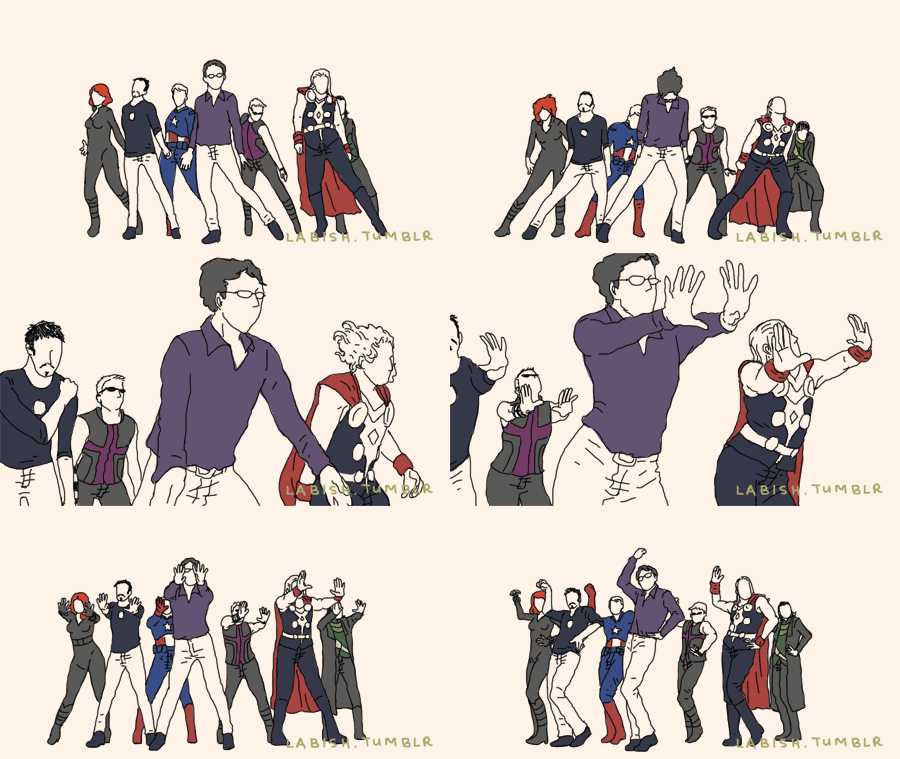
Likewise I thought the last portion didn’t have nearly enough context for the story. Ovid is telling lots of commonly known tales, especially Jason and the Argonauts (who were basically the Avengers of their day). But not most people know these tales now, and Medea and Jason are such a huge myth and have such a large impact on each other that it seemed odd to just have the one episode without any real context besides an “oh, he’s on a quest and she’s the daughter of the dude he wants to steal from.” Jason is such a fascinating bit of classic mythology, and I would have enjoyed seeing more of him.

Overall I enjoyed this unit, but just wanted more context to go along with the stories. They’ve all got such great depth, and Ovid just kind of glances over them to get to the parts he wants to tell and then skips the rest as he jumps around. I'm nosy - I want to know all the juicy details and get into the real meat of the story. Ovid isn't concerned about that because he just assumes everyone already knows the tales. Guess it’s no wonder why Virgil ended up writing the Roman equivalent of the Bible even though Ovid lobbied really hard to get the job, is it?

(Just something fun - it's Avengers so it totally fits :P

Thursday, August 28, 2014

Week 2 Essay: A Not-So-Golden Unit

The unit Cupid & Psyche was an alright one. The myth is not often told except in classes on classical mythology, but it was still rather boring to me. The tale has bits and pieces of a hundred other myths and fairy tales (the mysterious lover, jealous sisters, the tasks to regain love lost, the journey to the underworld, and the box you can’t open, just to name a few) and isn’t told very differently than such tales normally are. The writing wasn’t as exciting as I thought it would be either - although that may have just been the translator. I’ve been hearing about the wonderful snark and sarcasm but I found very little of it.
The frame story of The Golden Ass was more interesting. Especially since this is obviously just an excerpt from the middle portion of the tale, so you had to figure out what was going on. Why did he get turned into a donkey, how did he return to normal? You had to look these questions up yourself, and those are the fascinating parts of the story. Lucius was an interesting character, and he seemed like a really snarky guy. I got the sense that he was a poet, and just found myself really fascinated by his character. I wanted to learn more about him.

(Bruno Pelletier as Gringoire)

Everywhere the main tale failed to thrill me, the frame story made up for it. Lucius was by far more interesting than Psyche, and I would have liked to have read more story with him and his actual adventures than the tale of two stupid lovers. Perhaps if this unit became more about The Golden Ass than Cupid & Psyche, with bits and pieces from Lucius’ adventures it would be more exciting to read. Then again, I’ve had a whole semester of Greek Mythology and studied fairy tales in several classes, so I could just be spoiled. Or to be perfectly honest my expectations were higher, considering I spent a whole semester reading Hesiod, Homer, and Virgil. It wasn’t a bad story by any means, I just found it boring.
______________________________________________________________________

Image info: Web Source. Screenshot of Bruno Pelletier from the Canadian-French musical  Notre-Dame du ParisWhen I thought of Lucius as he longed for pen and paper I immediately thought of poets, and this is the image that came to mind. This musical is taken from the book which inspired Disney's The Hunchback of Notre Dame. Unfortunately, Disney neglected this character, who in Victor Hugo's book is the only happy one at the end (then again, it is Hugo we're talking about). He's a poet who basically fulfills the role of narrator. He also is a starving artist (hence why when the Renaissance happens at the end he's the happy one) who winds up married to Esmeralda in name only in order to save his life. He's a very fun character who reminds me of Lucius and the more I think of it the more they correlate. 
Here's his one of his best songs: Temps de Catedrali